By Edy Werder, a tech blogger with 20 years of experience in IT infrastructure
Mini PCs are changing the game for home labs and small business servers. Most guides just list the specs, but they rarely explain why these small machines are so good for running servers.
I really like these small machines and use them for several of my own projects. For me, it’s important to have something compact and quiet. They’re also energy efficient and more powerful than you might expect.
In this guide, I’ll go over what makes a mini PC great for server use, what to look for when choosing one, and the best models you can get in 2026 for different needs and budgets.
Editor’s Note (Updated September 2026):
This update covers what actually changed in the market. RAM and SSD prices have risen sharply, so the buying advice in the price section is now the opposite of what it was. I added a Raspberry Pi comparison, a section on used and refurbished mini PCs, and dropped VMware ESXi, which no longer makes sense for a home lab. The Minisforum MS-01 remains my machine of choice and my top pick.

Best Overall: Minisforum MS-01
Best Value: Acemagic K1 or Beelink SER8
Need Help Choosing? Jump to the full comparison section below.
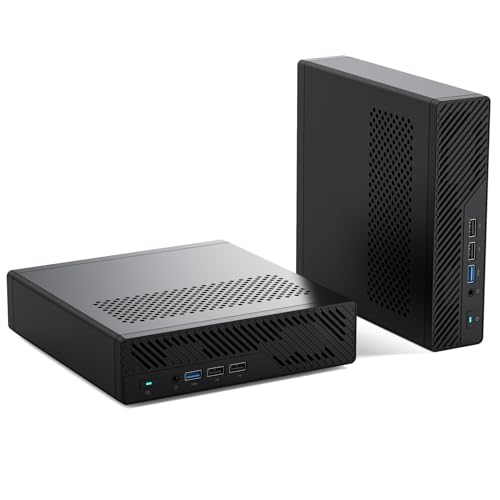
A mini PC is a full desktop computer packed into a box about the size of a paperback book. You still need your own display, keyboard, and mouse. But once it’s running, it behaves like any other Windows or Linux PC.
For a home lab or a small business server, the form factor is the real win. Mini PCs are smaller than traditional servers, making them ideal for space-constrained environments. A tower server eats floor space. A mini PC hides behind a monitor.
Mini PCs consume less power than traditional servers, which benefits long-term operational costs. That matters if you run it 24/7. Low power consumption also means less heat, and that usually means less noise.
Performance is usually “more than enough” for the typical server jobs people run at home. File sharing, backups, Home Assistant, a small Docker stack, Plex, AdGuard, Pi-hole, or a small web server. All of that runs great on x86 mini PCs. And because they are x86, you get broad compatibility. Most software and hypervisors are built for it.
Mini PCs often come with pre-installed storage and memory, simplifying the setup process for users. You unbox it, install your operating system, and you’re off. If you need more later, upgrades are often easy. Many units let you add RAM or swap the SSD without drama.
And then there’s the price. A mini PC is often cheaper than a “real” server. That makes them a very practical option for homelabers and small businesses.
Every home lab thread ends up here. A Raspberry Pi is cheap, tiny, and sips power. So why buy a mini PC at all?
A Raspberry Pi is ARM. A mini PC is x86. If you want to install Proxmox, the decision is already made for you: Proxmox VE requires a 64-bit x86 CPU. On a Raspberry Pi, you are looking at Docker on Raspberry Pi OS, or a lightweight Kubernetes setup instead.
Docker itself is less of a problem than it used to be. Most popular images ship multi-arch builds now. But you will still hit the odd container that is amd64 only, and that is an annoying thing to discover after you have built your whole stack.
If you are buying a Pi today, you are buying a Pi 5, so that is the board I am comparing against below.
Where the Raspberry Pi still wins
Where the mini PC wins
The Mac mini sits in the same ARM camp, by the way. The Mac mini is far more powerful than a Pi, but it shares the same basic limitation for a classic x86 mini PC homelab build.
The cost argument is weaker than it looks. Add a power supply, a case, an M.2 HAT, and an SSD to a Pi 5, and you are in mini-PC territory. A refurbished HP or Lenovo Tiny with 16GB RAM is often the better deal, and it comes with a proper NVMe slot and an Intel NIC.

I do have a Raspberry Pi. It is a Pi 3 Model B with 1GB of RAM, and it is not a server. It runs network utilities, including nmap and Webmin, and serves as a small rescue box on the network. For that job, it is still perfectly good, years after I bought it.
The interesting part is how it failed. Not the board. The SD card. I went to write a fresh image to it, and the verify step failed every single time. The card was simply worn out.
The symptom was not obvious either. The red power LED was on, the green activity LED never blinked, and an attached display showed no signal at all. That last part throws people, but it makes sense: the Pi 3 loads its graphics firmware from the SD card, so an unreadable card means it never gets far enough to output video. I replaced it with a 64GB high-endurance microSD, the type rated for constant small writes, and the activity LED was blinking again on the first boot.

The Pi 5 behaves very differently here, and it matters. The Pi 3 has no bootloader on the board at all. Everything comes off the SD card, so a dead card leaves you with a dead board, no diagnostics, and a blank screen. The Pi 5 has a bootloader in EEPROM on the board itself, so it can still display a diagnostic screen and boot messages even with no working card in the slot. If you are troubleshooting a Pi that will not start, knowing which generation you have tells you whether that blank screen means something or nothing.
The Pi 5 also solves the storage problem properly. It has a PCIe connector, so an M.2 HAT gives you a genuine NVMe SSD instead of a USB adapter, and it can boot from it. On a Pi 3 the only option is USB, and the Pi 3’s USB 2.0 bus is shared with the ethernet port, so an SSD there is not worth the money or the extra watts. For a utility box like mine, a high-endurance card is the right answer.
That is the detail I wish more guides mentioned. In a machine that runs around the clock, the SD card is a consumable. Logs, databases, and container writes grind it down, and you often only find out when you try to rebuild it. A mini PC boots from NVMe out of the box, with no HAT and no boot order to configure, and this entire failure mode goes away.
Where I landed. The Pi has a place in my setup. It is just not the server. Proxmox is my hypervisor of choice, and that one decision rules the Pi out. If your plan is a single service, like Pi-hole or a WireGuard VPN endpoint, a Pi is a fine and very power-efficient choice. If you want Proxmox, several containers, or more than 16GB of RAM, a mini PC is the sweet spot.
For a 24/7 mini server, I care more about idle watts and sustained efficiency than peak benchmark scores. The CPU still needs enough headroom for your workload. File sharing, backups, and a few Docker apps are easy. Multiple VMs, Plex transcoding, and heavier databases are not.
Idle power is the number that actually decides your running cost, and it is almost impossible to guess from a spec sheet. So I measured it. I ran a seven day comparison across three very different machines, a Dell PowerEdge T360, the Minisforum MS-01, and an Intel NUC, and wrote up the real numbers in my low power home server comparison. If electricity cost is what is driving your decision, read that one before you settle on a CPU. I am keeping the watt figures out of this guide so the two articles do not contradict each other.
Important Aspects I review
My recommendation
High-core-count Ryzen CPUs are often the best value for running virtualization workloads on mini PCs.
(Quick reality check: those “AI” chips are mainly found in premium compact PCs and laptops, not the average budget mini PC.)
Mini PCs are great because they disappear. But physics does not. Tiny cases can get loud under load.
Important Aspects I review
My recommendation
Pick a model with a reputation for quiet cooling and a bit of internal space. Fanless is nice, but only if performance and thermals stay stable.
Storage and RAM are the parts that decide how “server-like” your mini PC feels. Ideal mini PCs for homelabs support RAM upgrades and have efficient cooling systems for 24/7 operation.
Storage
16GB RAM is my minimum for a serious mini server. That is enough for a handful of containers, Home Assistant, and one or two light VMs.
32GB is the number I would actually plan for if you run Proxmox. 64GB makes sense if you keep several virtual machines running at the same time or store important data on your own storage in a VM-based NAS.
One detail people miss: check whether the machine has two SO-DIMM slots or soldered memory. A single-channel configuration costs you real bandwidth, and it also means you cannot upgrade later.
My recommendation
And yes, two M.2 slots are becoming more common, which is perfect for this use case.
Ports decide how flexible the box is in a year.
Networking capabilities, such as 2.5 GbE or 10 GbE support, are increasingly common in modern mini PCs.
Important Aspects I review
My recommendation
Minimum I like:
This is the part of the guide that changed the most since I first wrote it, and I would rather be blunt about it than pretend nothing happened. Memory and flash have gone through one of the sharpest price run-ups in years.
The numbers are hard to look at. TrendForce reported DRAM contract prices up 90 to 95% quarter over quarter in the first quarter of 2026, then another 58 to 63% in the second. NAND flash climbed 70 to 75% in the second quarter, and TrendForce still forecasts further increases of 13 to 18% for DRAM and 10 to 15% for NAND in the third quarter. HP has said memory and storage went from roughly 15 to 18% of its PC bill of materials to about 35%.
For a home server buyer, that changes the maths completely. The sticker price of the box is no longer the number that decides the total cost. A barebones mini PC plus 32GB of RAM and a 1TB NVMe can easily cost more in parts than in chassis.
Here is what I think is going on. The manufacturers know exactly how bad this looks on a product page, and they buy memory in volume at prices no individual can get. So they keep pushing bundled configurations that still land at a sensible number. That flips my usual advice for 2026.
My recommendation

Some mini PCs look upgradeable, then you discover one slot is missing, or everything is glued down.
Important Aspects I review
My recommendation
If you want maximum flexibility, I still like barebones. You control the parts and you can upgrade later without replacing the whole unit.
A home server gives you control. It can also be faster on your LAN than any cloud drive.
My recommendation
Keep sensitive files and backups at home. Use cloud as a second copy, not your only copy.
Here’s how I think about it:
Mini PCs are ideal for self-hosting projects. Thanks to their low power consumption, compact size, and surprisingly strong performance, you can run various services on your own hardware, without relying on third-party cloud providers.
Here are some examples of what you can self-host:
Some businesses also run lightweight customer relationship management (CRM) systems on a mini PC to avoid cloud-based subscription costs.
I run most of these on my own setup using Proxmox. You can assign containers or lightweight VMs to keep things organized.
Self-hosting gives you complete control, better privacy, and no subscription fees. A mini PC with a good CPU, 16–32GB of RAM, and NVMe storage is more than enough for running multiple services reliably.
Many small businesses and home users use their mini PCs for secure remote access, allowing them to access files or manage virtual machines from anywhere.
Self-hosting is more fun when the foundation is solid. My complete homelab guide shows how to plan the network, storage, and security around these services.
Looking for the right mini PC that balances power efficiency and capability for your small business server? These capable machines deliver enough performance to handle file servers, self-hosted applications, and backups—all while maintaining a compact, quiet, and energy-efficient profile that fits perfectly in any workspace.
The MS-01 is the machine I keep coming back to, and it is the one actually running in my lab. I like it enough that it got its own review.
On paper, it is an Intel Core i9-13900H, up to 64GB of DDR5, and dual M.2 NVMe slots. But the networking is what sets it apart: two 10G SFP+ ports plus two 2.5GbE ports. Ten gigabit in a box this size is still unusual, which is why the MS-01 can be the fast node in a small Proxmox cluster rather than the bottleneck.
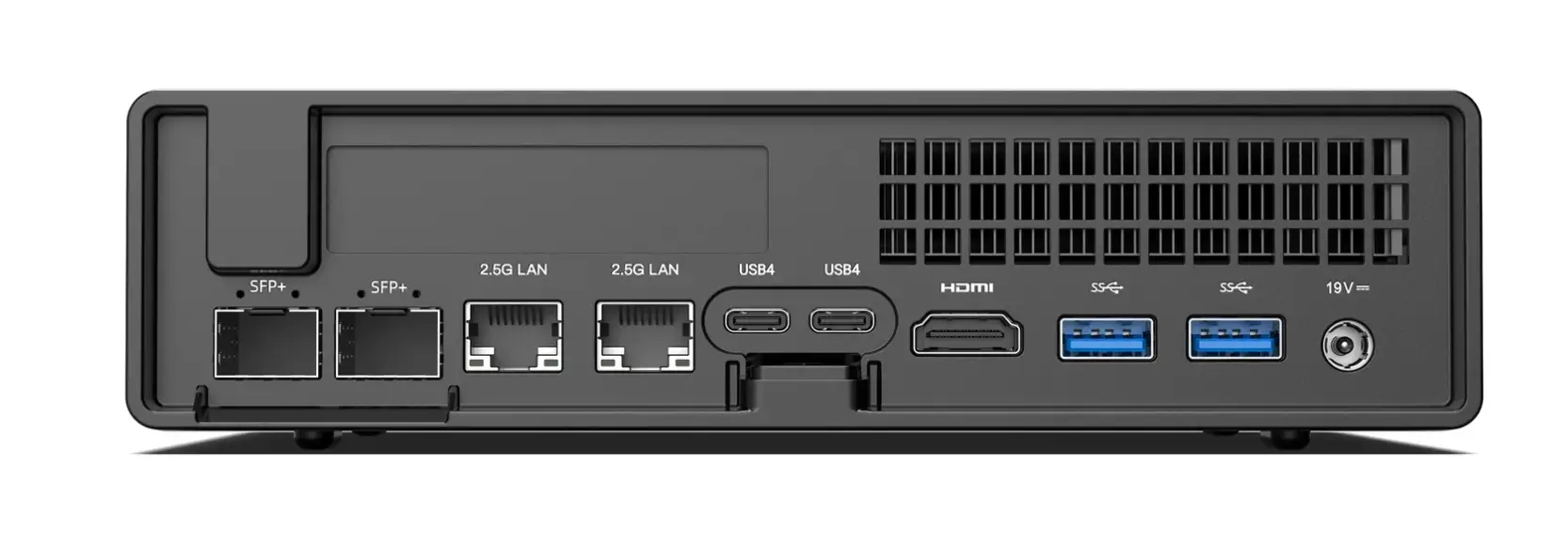
In practice it just runs. Proxmox installed without a fight, the Intel NICs meant no driver hunting, and it has the CPU headroom for multiple virtual machines, containers, media, and self-hosted storage at the same time. It is not the cheapest machine in this guide, and I would still buy it again.
What about the MS-03? Minisforum has a newer MS-03 out. On paper, it is a real step up, but right now it is priced well above what I would spend on a home server. I would wait for it to settle. Today the MS-01 is the better value.
The Minisforum MS-A2 is the same idea with an AMD Ryzen processor instead of Intel. Take whichever is cheaper on the day you buy.
The Minisforum MS-A2 features the same specs; the only difference is that it has an AMD Ryzen processor.
The ASUS NUC 15 Pro represents the newest generation of ASUS NUCs. Powered by Intel Core Ultra 7 255H processor with DDR5-6400 memory and Intel Arc graphics, it delivers unmatched speed and efficiency in a compact chassis
Key Features:
The ASUS NUC 15 Pro is compact yet powerful, designed for virtualization, media servers, and business applications. It works without a physical monitor, perfect for servers and remote management.
The HP Pro Mini 400 G9 Business Mini Desktop Computer is a powerful and efficient device with many impressive features. Here are the highlights:

Overall, the HP Pro Mini 400 G9 Business Mini Desktop Computer is a great choice for anyone needing a fast, reliable, and compact device for business or personal use.
Some product highlights
The AceMagic K1 is my “surprisingly capable budget Proxmox node”. On paper, it’s a simple, compact mini PC. In practice, the Ryzen 5 7430U has enough CPU headroom for a bunch of containers and a few light VMs.
It ships with Windows 11 Pro, but I wiped it and ran Proxmox VE for homelab testing. With 32 GB RAM and an NVMe boot drive, it feels responsive and stable for self-hosting. The main limitation is networking. You get 1 GbE, not 2.5 GbE. So it’s best for services and lab workloads, not as a high-speed NAS box.
Product Highlights:
The Beelink SER8 Mini-PC is a compact powerhouse featuring the AMD Ryzen 7 8845HS processor for efficient multitasking and high-speed performance. It has 32GB DDR5 RAM and a 1TB NVMe SSD, ensuring ample storage and fast data access. Operating on Windows 11 Pro provides a seamless user experience with modern features. The mini PC supports 4K UHD display, enhancing video and media streaming quality. With its extensive connectivity options, the Beelink SER8 is an excellent choice for those seeking a high-performance mini PC for home server applications.
I’d recommend it for anyone looking for a compact, versatile mini server.
Looking for an affordable entry into home servers? The GMKtec G3 Plus delivers surprising value for basic server tasks without breaking the bank.
Product Highlights:
Best For: Light server tasks, file sharing, media streaming, and budget-friendly virtualization. Perfect for students, families, or anyone needing a basic computer for everyday tasks.
Not Ideal For: Heavy virtualization, multiple VMs, or demanding workloads. This is an entry-level option best suited for simple home server projects.
This budget model uses a Realtek network chip, which may not work with VMware ESXi without workarounds. For ESXi compatibility, consider models with Intel NICs, such as the Intel NUC or the Minisforum MS-01.
Someone on Reddit mentioned running the GMKtec K1 successfully on Proxmox with 32GB of RAM.
The GMKtec K11 is the machine I’d recommend if you want serious horsepower in a mini PC form factor. It runs an AMD Ryzen 9 8945HS with 8 cores and 16 threads, boosting up to 5.2 GHz. That is enough CPU for running six or more VMs on Proxmox without breaking a sweat.
It ships with 32GB DDR5 RAM at 5600 MT/s. You can upgrade to 96GB, which gives you plenty of headroom for heavy virtualization. Storage is covered by dual PCIe 4.0 M.2 2280 SSD slots that support up to 8TB total.
The networking is a standout. The K11 comes with dual Intel i226V 2.5GbE NICs. That is a real advantage for anyone running a firewall VM, setting up link aggregation, or separating management and VM traffic. No USB-to-Ethernet adapter needed. For comparison, the cheaper GMKtec M5 uses a Realtek NIC, which is a step down for server use.
You also get dual USB4 ports at 40 Gbps, an Oculink port for external GPU setups, HDMI 2.1, and DisplayPort 2.1. That makes it one of the most connected mini PCs in this price range.
Power consumption sits around 10 to 14 watts at idle, depending on BIOS settings. Under full load in Performance mode, it can reach about 96 watts. The BIOS offers three power profiles: Quiet (35W), Balanced (54W), and Performance (65W TDP). Wake-on-LAN and Auto Power On are available too, which matters for headless server operation.
On Reddit, a user confirmed running Proxmox on the K11 with a full Arr stack in a Debian 12 VM and reported zero problems. Other users on the Proxmox forum are equally positive, with one planning to buy a second unit.
A common question is whether you need an Intel chip for media transcoding. The short answer: not anymore. Jellyfin natively supports AMD hardware transcoding, so the Radeon 780M in the K11 handles transcoding just fine. The “you need Intel Quick Sync” advice is outdated if you use Jellyfin.
Keep in mind that iGPU passthrough (Radeon 780M) to VMs has known issues with the AMD reset bug. If GPU passthrough is your main goal, the Oculink port with a discrete GPU is the cleaner path.
If you don’t need the top-tier chip, consider the GMKtec K8 Plus. It uses the AMD Ryzen 7 8845HS instead of the 8945HS but shares the same chassis, BIOS, drivers, and dual Intel i226V NICs. In practice, the performance difference between the two is negligible.
The only real weakness reviewers consistently mention is Wi-Fi range. For a server that sits on a wired connection, that does not matter.
Best For: Running multiple VMs on Proxmox, Docker stacks, media servers with AMD transcoding, home automation, and anyone who wants the most powerful mini PC in this guide without paying the Minisforum MS-01 price.
Not Ideal For: If you only need a simple file server or a single lightweight VM, the K11 is overkill. Start with the GMKtec G3 Plus instead.
Some product highlights
The ThinkCentre M90q Gen 5 is my “safe business pick” for anyone who wants a mini server that just runs. It’s a proper enterprise Tiny box, so sourcing, documentation, and long-term reliability are usually better than with many consumer mini PCs. It also gives you real upgrade options: two NVMe slots for fast storage and even a PCIe slot for expansion.
For home labs, this model is a good fit. You can set up a solid Proxmox node with fast NVMe storage and enough RAM for virtual machines. If you want a mini PC that feels business-grade and stays flexible for future upgrades, this is a strong option.
I list the Mac mini M4 only as an honorable mention because it uses Apple Silicon (ARM), so it’s not a great fit for typical x86 home server setups like Proxmox VE (which requires Intel 64 or AMD64). Many virtualization stacks on Apple Silicon run ARM-only guests.
The Apple Mac mini with Apple M4 Chip is a game-changer in the world of technology. Here are some highlights of its features:
If the budget is tight, the best mini PC for a home server is often one that has already spent three years under someone’s desk. Ex-corporate Tiny and Micro machines hit the market in large volumes and are built for exactly the kind of 24/7 duty a home server demands. With RAM and SSD prices where they are in 2026, a used unit that already has 16GB installed is a better deal than it has been in years.
Before you buy anything, check what you already own. An old desktop PC with a recent enough CPU makes a perfectly good first home server. It consumes more power than a mini PC and takes up more space, but the hardware is already paid for.
If you do buy, the models to look for are the HP EliteDesk and ProDesk Mini, the Lenovo ThinkCentre Tiny, and the Dell OptiPlex Micro. All three lines share the same basic advantages:
What I check before buying used
The total cost of a used Tiny with 16GB of RAM and a fresh NVMe SSD usually comes in well under the price of a new mini PC with similar specs. You give up 2.5GbE and USB4, and you get a machine with a known service history instead. For a file server, a backup target, or a first Proxmox node, that is a trade I would take.
The Acemagic K1 and Beelink SER8 Pro are also fast options for home server tasks. They are not as powerful as the MS-01, but they offer good value for the price.
Check that your mini PC server works with the operating system you plan to run. I use Proxmox on my own setups, and it works with almost all of this hardware. Setting up a small Proxmox cluster with three nodes is an affordable way to try clustering and get high availability in your home lab.
Please check out my virtualization category blogs.
I’d love to hear from you. Was this article helpful? Share your thoughts in the comments below. If you prefer, you can also reach me by email or connect with me on Reddit at Navigatetech.
Hi, I'm Edy Werder. I write hands-on guides about servers, virtualization, NAS and WordPress, based on setups I run in my own homelab. Real configs and real results, no fluff.
Enjoying the content?